












































1 min read
Why Every Company Needs an AI Policy in 2026
Artificial intelligence is rapidly transforming the workplace. Employees are using AI tools to draft emails, analyze data, generate content, write...

Tailored consulting, engineering, and managed security services to meet your needs.
Discover who we are, what drives us, and how Cortrucent partners with businesses to deliver lasting security and technology success.
Explore Cortrucent’s latest insights, industry updates, and expert resources to strengthen your cybersecurity and IT strategy.
2 min read
Madison Bocchino
:
July 31, 2026
Artificial intelligence is transforming the way businesses operate, but it's also changing how cybercriminals conduct their attacks.
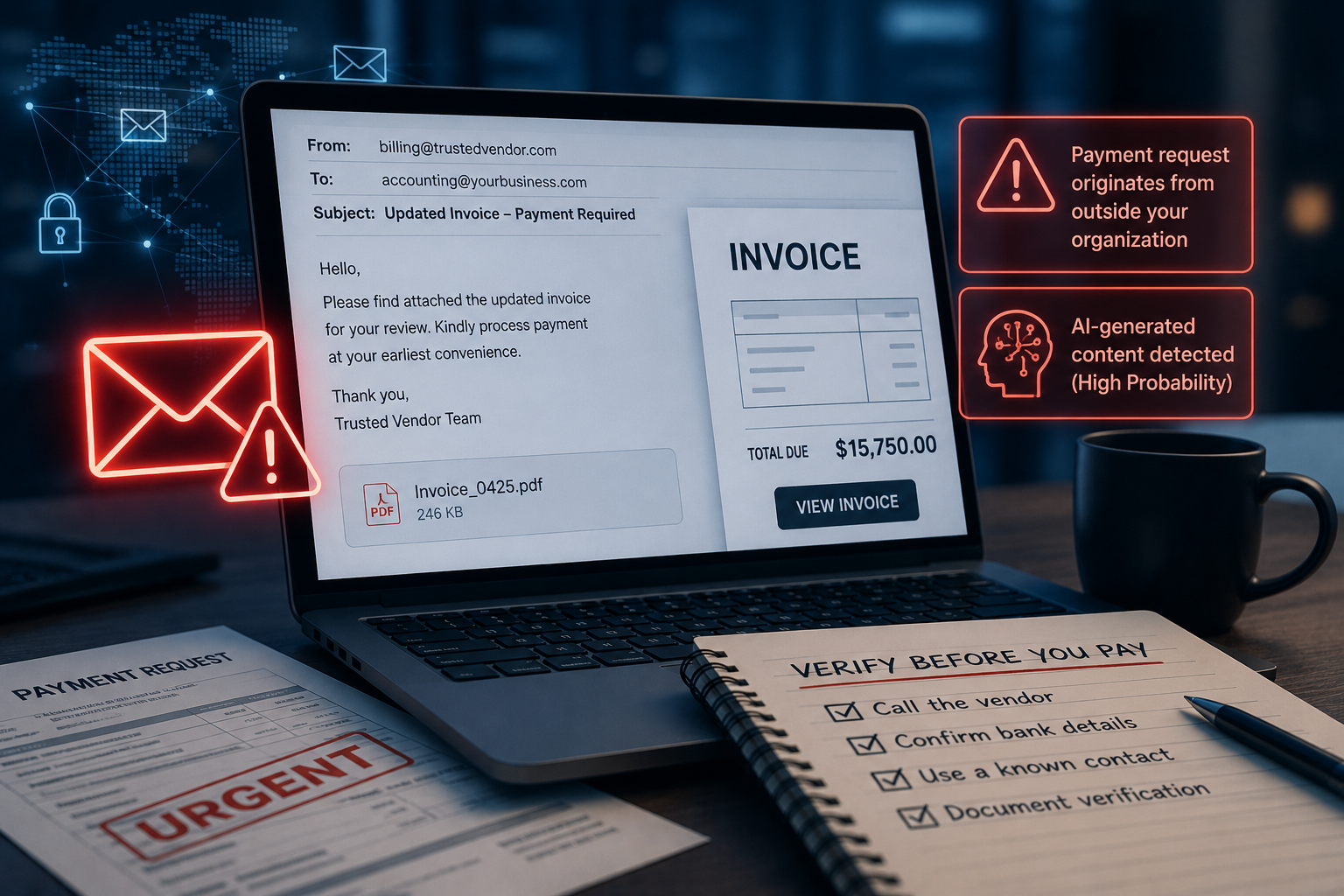
One of the fastest growing threats organizations are facing is AI-powered invoice fraud. By using artificial intelligence to create convincing payment requests, invoices, and business emails, attackers are making traditional phishing scams far more difficult to identify.
What was once easy to recognize as a suspicious email can now appear almost identical to legitimate business communications.
AI-powered invoice fraud is a type of business email compromise (BEC) attack in which cybercriminals use artificial intelligence to create realistic invoices, payment requests, or vendor communications.
Rather than relying on poorly written phishing emails, attackers use AI to produce professional looking messages that closely resemble legitimate business communications.
These scams are designed to convince employees to approve payments, updated banking information, or transfer funds to fraudulent accounts.
Cybercriminals often begin by gathering publicly available information about an organization and its vendors.
Using AI, attackers can generate emails that mimic:
In some cases, attackers compromise legitimate email accounts before sending fraudulent invoices, making the messages even more convincing.
The result is an email that appears authentic and creates a sense of urgency, encouraging employees to act before verifying the request.
Artificial intelligence allows attacks to create highly personalized messages in seconds.
Instead of sending the same phishing email to thousands of recipients, cybercriminals can generate customized payment requests tailored to specific organizations, departments, or individuals.
This personalization makes it significantly more difficult for employees to recognize warning signs.
As AI tools become more accessible, businesses should expect these scams to become faster, more sophisticated, and increasingly difficult to detect.
A single fraudulent payment can have significant financial consequences.
Organizations affected by invoice fraud may experience:
Because these attacks often target finance departments and executives, the financial impact can be substantial before the fraud is discovered.
Technology plays an important role in preventing email based attacks, but strong business processes remain equally important.
Organizations should consider the following best practices:
A simple verification process can prevent significant financial losses.
AI is making cybercriminals more efficient, allowing them to create convincing scams at a speed and scale that wasn't possible just a few years ago.
While artificial intelligence offers tremendous opportunities for businesses, it also raises the bar for cybersecurity awareness.
Organizations that combine strong security controls with clear financial verification procedures and ongoing employee training will be better positioned to identify fraudulent requests before money changes hands.
When it comes to payment requests, a quick phone call or secondary verification may be the difference between stopping a scam and becoming its next victim.
1 min read
Artificial intelligence is rapidly transforming the workplace. Employees are using AI tools to draft emails, analyze data, generate content, write...

1 min read
Artificial intelligence is changing the way people work, communicate, and interact online, but it is also creating new opportunities for...
1 min read
For years, cybersecurity strategies focused on protecting the network perimeter, firewalls, antivirus software, and intrusion detection systems. But...